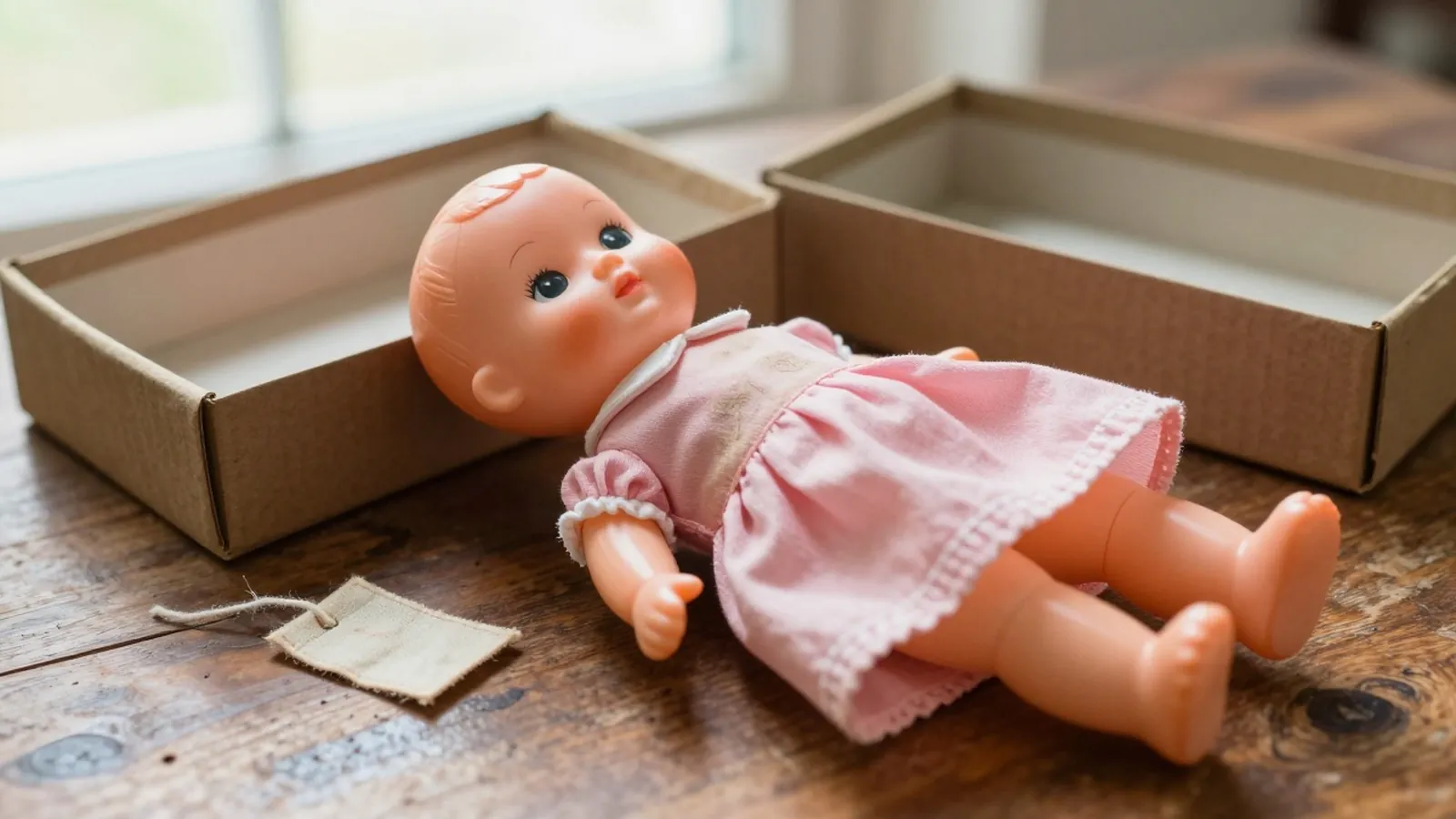
Madame Alexander doll value is the price a specific Alexander Doll Company doll can realistically bring, set mostly by its era and material, its condition, and whether the original tag, outfit and box survive. The doll's marks, tags and material tell you which era it belongs to, and completed sales of the same model show what buyers actually pay.
Madame Alexander doll value isn't one number for the brand. It's the realistic price for one doll, and it comes from four things you can check yourself. First, identity and era: the marks on the head or back, the clothing tag and any box label tell you what the doll is and roughly when it was made. Museum records show the pattern, from composition dolls of the 1930s to plastic dolls around 1950 and soft vinyl by the 1960s. Second, condition: crazing, faded faces, cut or replaced hair and missing pieces lower the price. Third, completeness: the original outfit, wrist or clothing tag and box matter a lot to collectors. Fourth, the evidence you price from: a completed sale of the same doll is stronger than an asking price on an open listing, and neither is an appraisal. If the doll could be worth a lot, or you plan to donate it for a tax deduction, a qualified appraiser is the right next step.
What Sets a Madame Alexander Doll's Price
Four things move the price, and you can check every one of them at the kitchen table.
- Era and material. Composition, hard plastic and vinyl dolls come from different decades, and collectors pay differently for each.
- Condition. Clean, uncracked faces, original hair that hasn't been cut, and working sleep eyes hold value. Crazing, fading, stains and repairs lower it.
- Original outfit and tags. A doll in its factory clothes, with the sewn tag still attached, is worth more than the same doll redressed.
- The box. A box with a readable label adds value on its own and also helps identify the doll.
Check all four before you look up a single price, because a match on name alone can point you to a doll worth far more or far less than yours.
How to Identify Your Doll From Its Marks and Tags
Start with the marks, because the name on a listing means nothing until you can match it to your doll.
Look at the back of the head and the upper back. A 1930s composition Dionne Quintuplet doll at The Henry Ford is marked "DIONNE" and "ALEXANDER" on the back of the head and "MADAME ALEXANDER" on its back, and its clothing tag reads "DIONNE QUINTUPLETS / MADAME ALEXANDER / REG. N.Y." (museum record). The V&A's 1936 to 1938 Dionne set has "ALEXANDER" moulded on the nape and upper back of each doll (V&A record).
Next, check the clothes. The Henry Ford's circa 1950 plastic doll has an apron tag reading "Madame Alexander / ALL RIGHTS RESERVED / NEW YORK U.S.A.", and its box label records a style number, STYLE 2536A, plus checkmarks next to a color (pink) and a hair shade (blonde) (museum record). If you have the box, search with that style number, since it points to one specific model and outfit.
Then look at the face and body. The V&A's 1963 "Marmee" from Little Women is moulded soft vinyl with rooted saran hair, grey plastic sleep eyes and the "Elise" face, and stands 29.2 cm tall (V&A record). Comparing your doll's face with dated museum examples like this one narrows the era before you compare prices.
Era and Material at a Glance
These are dated museum examples, not a full chronology, but they show the material change you'll see in your own hands.
| Museum example | Date | Material | Marks to look for |
|---|---|---|---|
| Dionne Quintuplet doll, The Henry Ford | 1935 to 1939 | Composition | "ALEXANDER" on head, "MADAME ALEXANDER" on back, cloth tag |
| Dionne Quins set, V&A | 1936 to 1938 | Composition | "ALEXANDER" moulded on nape and upper back |
| Madame Alexander doll, The Henry Ford | circa 1950 | Plastic | Apron tag, box label with style number |
| "Marmee" doll, V&A | 1963 | Soft vinyl, saran hair | Elise face, sleep eyes |
Composition feels slightly warm and can show fine surface cracks (crazing). Hard plastic is rigid and cool. Soft vinyl gives a little when pressed, and the hair is rooted into the scalp rather than wigged.
Asking Prices, Completed Sales and Appraisals
Three kinds of number get called "value," and mixing them up leads to the wrong price.
- Asking price: what a seller hopes to get on an open listing. It can sit unsold for months.
- Completed sale: what a buyer actually paid. This is your best evidence, especially when the doll, size, outfit and condition match yours.
- Appraised value: a written opinion from an appraiser for a stated purpose, such as fair market value for a donation or replacement value for insurance.
Price guides need care too. IRS Publication 561 says that if you use a price guide for a donated collectible, it must be the current edition at the date of the contribution, and it warns that dealers' price lists aren't always reliable indicators of fair market value (IRS Publication 561). An old printed guide is a history lesson, not a price.
To price your doll, search completed sales using the doll's name, size and style number, and compare only dolls with the same outfit and similar condition.
When to Get a Qualified Appraiser
Get an appraiser when the doll looks like an early composition or 1950s hard plastic piece in original clothes, when you're dividing an estate, or when you plan to donate.
Donation has firm rules. IRS Publication 561 names dolls among the most common donated collectibles, and a deduction of more than $5,000 for art or collectibles must be supported by a qualified appraisal and Form 8283. The same publication says no part of a qualified appraiser's fee can generally be based on a percentage of the appraised value (IRS Publication 561). That's a good rule to follow even outside donations: be wary of anyone who wants a cut of the number they give you.
You can find credentialed personal property appraisers through the American Society of Appraisers, the International Society of Appraisers and the Appraisers Association of America. Ask whether they handle dolls or toys before you book.
A Quick First Read With Antiqly
If the doll is in front of you and you don't know where to start, a photo is a reasonable first step. Antique Identifier: Antiqly identifies antiques from a photo and suggests a name, period, origin and a short history of the piece. You can add up to four extra photos, such as the head marks, the clothing tag or the box label, plus a short note to steer the identification.
If a maker's mark is visible, Antiqly describes it and gives its interpretation with a confidence level. The price it shows is a range based on comparable secondhand listings, with the number of listings it's based on. That's an estimate from asking prices, not an appraisal, so use it to decide whether the doll deserves a closer look. Antique Identifier: Antiqly is available on iOS and Android.
Common questions
Are Madame Alexander dolls worth anything?
It depends on the specific doll. Era and material, condition, and whether the original outfit, tag and box survive decide where your doll falls, so identify it first and then compare completed sales of the same model.
How can I tell how old my Madame Alexander doll is?
Check the material first: composition matches museum examples from the 1930s, rigid plastic matches one from around 1950, and soft vinyl with rooted hair matches one from 1963. Then read the marks on the head and back, the sewn clothing tag and any style number on the box.
Does the original box matter?
Yes. A box with a readable label adds value and often carries the style number, which is the best way to match your doll to completed sales of the same model.
Where should I sell a Madame Alexander doll?
For common dolls, general online marketplaces work. Early or complete dolls in strong condition are worth taking to a specialist doll auction house or dealer. Get an appraisal first if you think the doll is valuable.