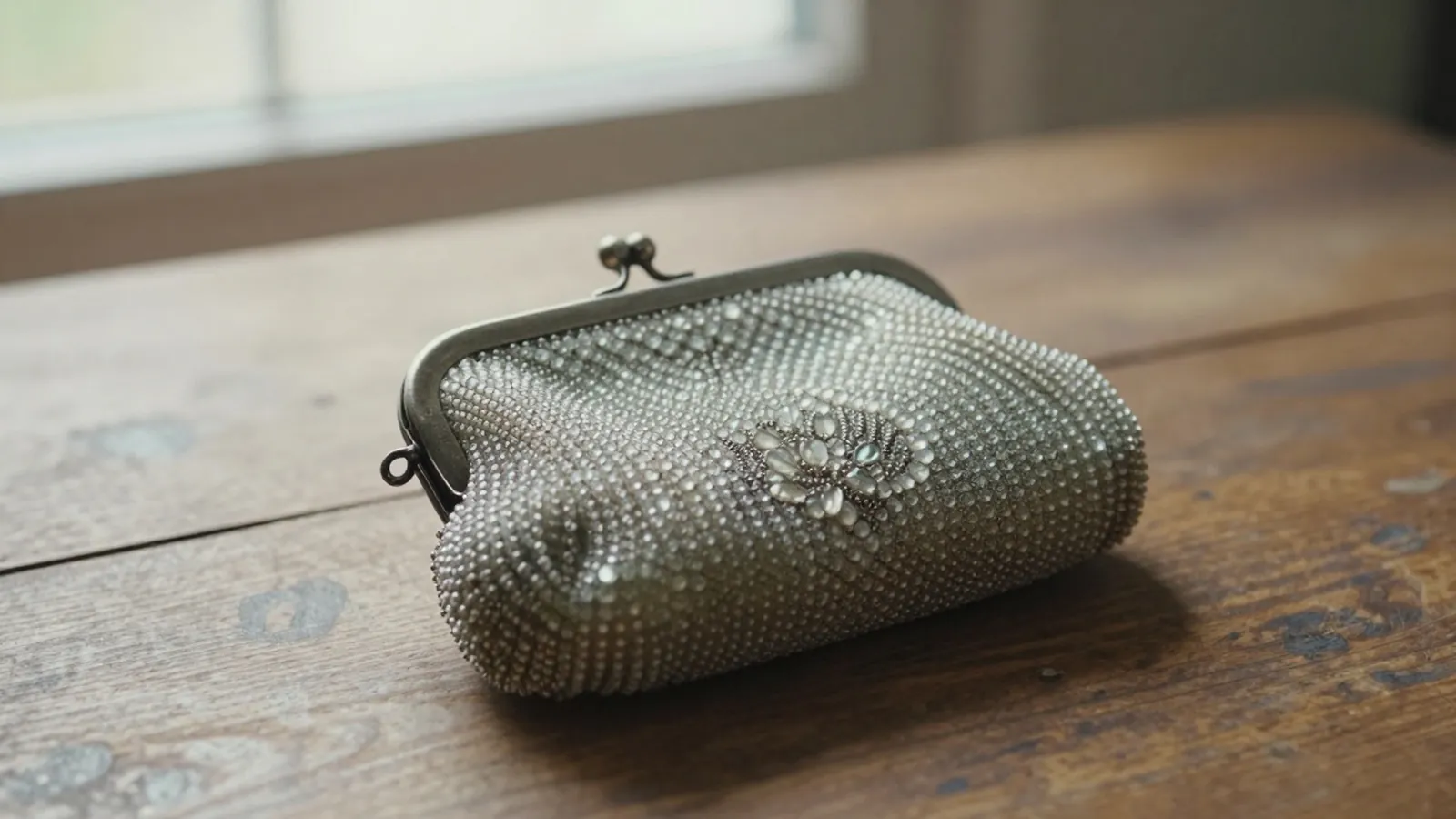
Antique beaded purse value is the price a specific bag can realistically bring, set by four things: how fine and dense the beadwork is, what the frame is made of, whether the original lining survives, and condition. On Antiques Roadshow, a French glass beaded bag from about 1920 was updated to $900 retail in 2018, and a 1931 bag with an 18 karat gold and jade frame was valued at $4,000 to $5,000 retail in 2017.
An antique beaded purse is a small bag covered in glass or metal beads, usually sewn, knitted or crocheted, made in quantity from the Victorian era through the 1930s. Its value isn't a fixed number from a price guide. It's the result of a short chain of evidence. First comes identification: bead type (glass seed beads or faceted cut steel), bead density, pattern and era. Next is the frame: stamped steel is common, while sterling or gold frames, sometimes set with stones, push a bag into a higher bracket. Then condition: missing beads, broken fringe, rusted steel beads and a removed lining all pull the number down, and collectors prefer a damaged original lining to a replacement. Finally, check which kind of price you are reading: an asking price, an auction result or an appraiser's retail value. They are different numbers for the same bag.
Bead Type and Density: The First Price Clue
Start with the beads themselves, because they tell you both age and quality.
Glass seed beads are the most common. The finer they are, the more beads fit into each inch and the more detailed the pattern can be. On the French beaded purse appraised on Antiques Roadshow, the appraiser estimated roughly 150 beads to the square inch on a floral bag from the 1915 to 1925 era and called it a purse of exceptional quality.
Cut steel beads look like tiny faceted metal studs. The Philadelphia Museum of Art explains how Victorian makers produced them: holes were pressed into soft iron sheet, the beads were shaped into spheres, fired, hardened into steel in a cold water bath, then faceted on a flat metal wheel and polished. Thomas Gill described the process in his 1830 Scientific, Technological & Microscopic Repository. That labor is why crisp, bright cut steel work is valued.
| Clue you can see | What it usually suggests |
|---|---|
| Very small glass beads, dense pattern | Higher quality work, often 1910s to 1920s |
| Faceted metal beads | Cut steel, Victorian to early 1900s |
| Larger, dull, rusted steel beads | Likely American made, early 1900s |
| Plastic beads | Later production, after glass and metal beads |
Table based on the Philadelphia Museum of Art, La Crosse County Historical Society and Antiques Roadshow records cited on this page.
Rusted Steel Beads and Where a Purse Was Made
Rust on a steel beaded bag isn't only a condition problem. It's also a clue to origin.
According to the La Crosse County Historical Society, steel beaded bags became so fashionable in the early 1900s that American companies began making their own steel beads. Those American beads rusted much faster than French ones, and they were larger and duller. So a bag with big, flat looking, rust spotted steel beads is more likely American. Small, sharp, still bright beads point toward French work, which collectors tend to prize.
Glass beaded bags carry other origin hints. One Roadshow appraiser noted that American women who made purses at home often placed a single white bead in one quadrant of the pattern, so its absence was part of her case for a French bag. Treat that as a lead to check, not a rule: many factory and home bags break it.
Frame, Clasp and Lining
The frame can matter as much as the beadwork. Look at the top hinge and clasp under good light and check for stamped marks.
Most frames are stamped steel or base metal, sometimes sold as "German silver," which contains no silver at all. These don't add much by themselves. A precious metal frame changes the picture: a 1931 Walton & Co. bag on Roadshow had an 18 karat gold frame set with jade plaques and drew a $4,000 to $5,000 retail value in 2017.
Next, open the bag. An original lining, original mirror and working clasp all help. Collectors would rather see a damaged original lining than one that was removed or replaced, a point the appraiser made about a hand-beaded purse from about 1900.
Don't date a bag by its lining alone. The Metropolitan Museum of Art has a Mexican beaded purse from 1800 to 1820 lined with an 18th-century dress silk, an example of older silks being reused. A lining can be older than the bag it sits in.
Condition: What Lowers the Price
Condition is where most beaded purses lose value. Check these points in order:
- Missing beads. Small gaps are common; bare patches or loose threads that keep shedding beads are serious.
- Fringe and tassels. Broken or shortened fringe is easy to see and buyers notice it first.
- Rust and tarnish. Rust on steel beads stains the fabric beneath and can't really be reversed.
- Shape. A heavy bag can stretch out of shape over time; a flat, even body is better.
- Frame and hinge. A frame that won't close, or a replacement frame, cuts value.
- Repairs. Restringing with modern beads or thread lowers value for most collectors, even if it looks tidy.
Photograph the front, back, base, frame edges, any marks and the inside before you clean anything. Washing or restringing a fragile bag can do more harm than the dirt.
How to Read Price Data for a Beaded Purse
Prices you find online aren't all the same kind of number. Asking prices are what sellers hope to get on active listings. Auction figures are what a bidder paid on one day. Retail and replacement values from an appraiser reflect what it would cost to buy a similar bag from a dealer. Antiques Roadshow notes that an auction figure can often be about half of retail.
Values also move with the market. Two Roadshow records show how far:
| Roadshow record | First value | Updated value |
|---|---|---|
| Hand-beaded purse, ca. 1900 | $1,000 to $1,200 auction (2001) | $450 to $500 auction (2016) |
| French beaded purse, ca. 1920 | $2,000 retail (2005) | $900 retail (2018) |
So an old appraisal, or a price in an old book, may be far from today's market. Compare your bag only with pieces of the same era, bead type, frame metal and condition, and look for what buyers actually paid rather than what sellers are asking.
When to Call an Appraiser
Most beaded purses don't need a formal appraisal. Get one when the bag has a gold or sterling frame, very fine glass or cut steel work in strong condition, a known maker, or when you need a written value for a specific purpose.
Charitable gifts are the clearest case. IRS Publication 561 says a deduction of more than $5,000 for donated art and collectibles must be supported by a qualified appraisal and a Form 8283.
For a written appraisal, look for an accredited member of the American Society of Appraisers or the International Society of Appraisers who handles textiles, costume or decorative arts. Tell them the purpose (sale, insurance replacement, estate or donation), because the type of value changes with it. Avoid anyone who charges a percentage of the value they assign, since that rewards a higher number.
A Quick First Read From a Photo
If you have the bag in front of you and want a starting point before deciding on an appraiser, Antique Identifier: Antiqly can give you a first read from a photo on iOS and Android. It suggests a name, period, origin and a short history of the piece.
You can add up to four extra photos, such as the frame stamp, the lining or a damaged area, plus a short note to steer the identification. If a mark is visible on the frame, Antiqly describes it and gives its interpretation with a confidence level.
The price shown is a range based on comparable secondhand listings, with the number of listings it is based on. It's an estimate, not an appraisal, and it can't confirm frame metal or bead type the way a hands-on examination can.
Common questions
How much is an antique beaded purse worth?
It depends on beadwork, frame and condition. Fine, dense beadwork in good condition and a precious metal frame push the price up, while missing beads, rust and replaced parts pull it down. On Antiques Roadshow, a French glass beaded bag was valued at $900 retail in 2018 and a bag with an 18 karat gold and jade frame at $4,000 to $5,000 retail in 2017.
How can I tell how old my beaded purse is?
Look at the bead type, the frame and the style. Faceted cut steel beads suggest the Victorian era to the early 1900s, and larger rusted steel beads often point to American work from the early 1900s. Fringed Art Deco patterns are typical of the 1920s. The lining alone isn't reliable, because older fabric was sometimes reused.
Should I repair or clean my beaded purse before selling?
Usually no. Restringing with modern beads, replacing the lining or washing a fragile bag can lower its value. Photograph it as it is and let a buyer or appraiser judge the condition.
Are vintage beaded purses from the 1950s worth anything?
Purses from the 1950s came in many sizes and materials, and the La Crosse County Historical Society shows a beaded one with an interior tag reading "Bag by Debbie Hand-made in Japan". Compare yours with other 1950s bags rather than with fine pre-1930s work, and note that condition, a maker's label and an unusual design still make a difference.